
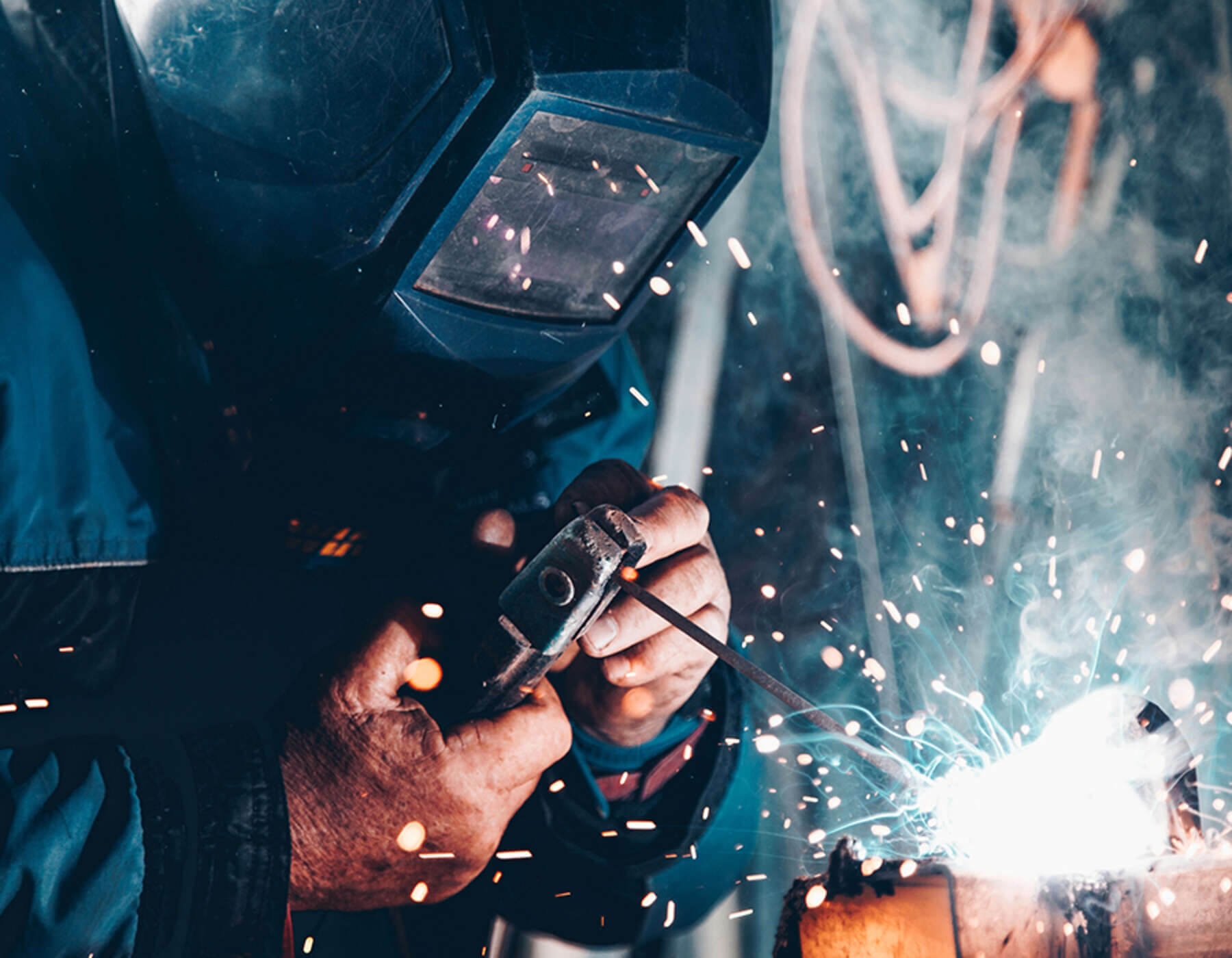
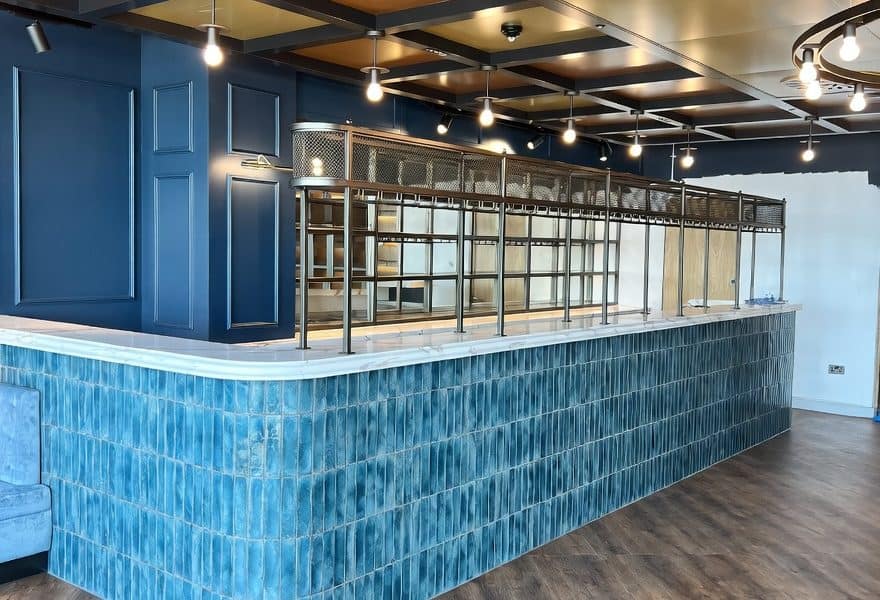
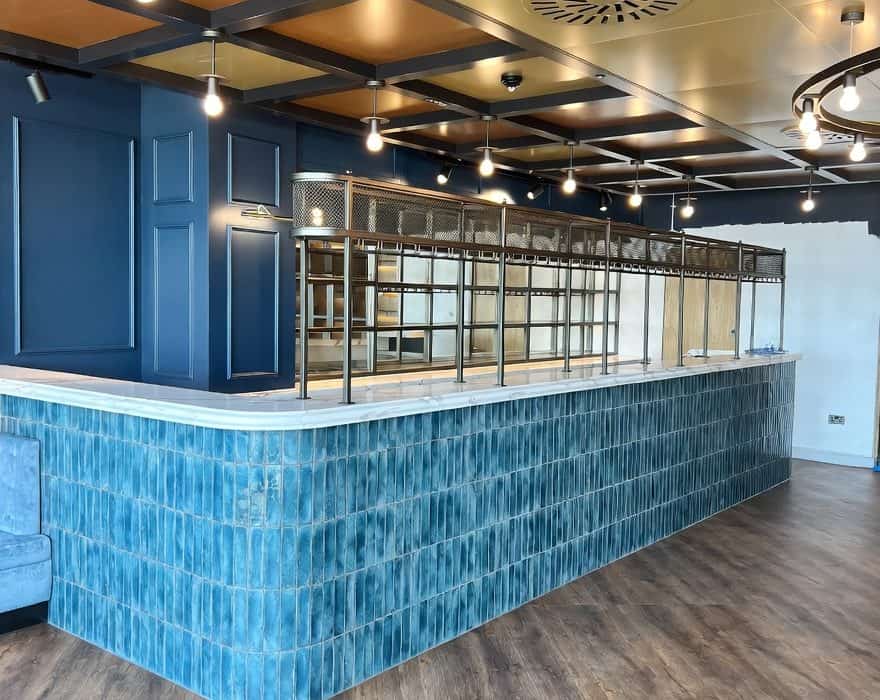
In 2025 we made more than 250 bespoke architectural metalwork items for the West Stand hospitality areas at Everton Stadium, Bramley-Moore Dock. Bar gantries, screens, booth frames, servery counters, display cabinets. That job is a fair summary of what hospitality metalwork involves, so this post uses it to explain how we work with fit-out contractors and designers on bars, restaurants and venues.
What we make for hospitality fit-outs
Most of it is joinery-scale work in steel. It has to look right up close and still go in on a fit-out programme.
- Bar gantries. Overhead frames above the bar for glass racks, lighting and signage, hung from the soffit or posted off the counter.
- Back bars. Shelving frames and bottle displays behind the bar, often with lighting runs built in.
- Screens and dividers. Flat bar, mesh, perforated sheet or CNC-cut patterned panels to break up a floor.
- Booth frames. Steel frames for booth seating, ready for the upholsterer.
- Servery and bar counter frames. Structural frames for the counter, with steel or brass cladding, kick plates and foot rails.
- Display cabinets. Steel framed cabinets for merchandise, trophies or bottles, glazed by others.
Then there’s the odd stuff. Planter frames, menu boards, handrails, brackets for things nobody’s designed yet. A fit-out always throws a few of those up.
Mixing materials
Designers rarely want plain steel in a bar. On Everton we worked in brass, copper and blackened steel alongside powder coated mild steel. That’s typical.
Mild steel does the structural work. Gantries, counter frames and booth frames are nearly always mild steel underneath, whatever they’re clad in.
Stainless steel goes where there’s food, drink, water or cleaning chemicals. Servery tops, kick plates, wash-down areas. We do a lot of stainless steel fabrication for food-grade conveyor systems, so we’re used to the hygiene side.
Brass and copper are mostly used as trims, cladding sheets, foot rails and accents over a steel frame. They’re soft and expensive, so it makes sense to let the steel carry the load and keep the brass where people can see it. Both will darken and mark with handling unless they’re lacquered, so decide early whether you want them to age or stay bright.
Blackened steel gives that dark, slightly uneven industrial look. It’s a chemical finish rather than a coating, so it needs sealing and it’s better kept away from wet areas and heavy wear.
Different metals touching each other in damp spots can cause galvanic corrosion, so we detail isolation between them where it matters.
Finishes
Most of the mild steel on a hospitality job is powder coated, and we do that in-house. Our oven takes pieces up to 8m long, 3.5m high and 3m wide, so a full-length bar gantry goes through in one piece instead of being split and joined on site. The Everton steelwork was coated here too. Fabricating, coating and packing under one roof means no waiting on a coating subcontractor.
Pick from the 213 colours on our RAL colour chart in matt, satin or gloss. Dark matt finishes are popular in bars. They hide fingerprints better than gloss, and they sit well next to brass.
Working with fit-out contractors and designers
On hospitality jobs we’re usually a subcontractor to the fit-out contractor. At Everton the main contractor was Overbury. The designer’s drawings set the look, and our job is to turn them into something that can be made, fixed and maintained.
That usually means:
- Taking design intent drawings and producing fabrication drawings in our own CAD and design engineering team
- Working out fixings into soffits, slabs and stud walls, and where the services run
- Sending samples of finishes and material combinations for sign-off before production
- Coordinating with the joiner, glazier and electrician so the gantry lights and the cabinet glass actually fit
Raise anything structural early. A gantry hanging from a soffit full of glassware is a real load, and if there’s a balustrade at a raised bar area or mezzanine, the guarding has to meet Approved Document K heights and the higher crowd loading that applies to bars.
Programme and install
Fit-outs run tight. Metalwork usually sits on the critical path because the joinery, glazing and lighting all fix to it. What helps:
Agree a drawing sign-off date and stick to it. Once drawings are approved, fabrication and coating are in our control and run quickly.
Let us site measure where we can. Hospitality spaces are rarely square, and a gantry made to drawing dimensions in a room that’s 15mm out won’t hang straight.
Plan delivery around site access. Finished, coated metalwork gets wrapped and labelled by area so it goes straight to where it’s fitted. On a stadium job with 250+ items, labelling isn’t optional. Our dispatch and installation team works across the UK.
More detail on the stadium job is in our Everton Stadium case study.
FAQs
Do you make bespoke bar gantries?
Yes. We design, fabricate and powder coat bar gantries in-house, either suspended from the soffit or supported off the bar counter, sized to your glass racks and lighting.
Can you work in brass and copper as well as steel?
Yes. Brass and copper are usually used as cladding, trims and foot rails over a steel frame. We did this on the Everton Stadium hospitality areas.
Do you work directly with designers or through the fit-out contractor?
Both. Most of the time we’re contracted by the fit-out contractor, but we’re happy to talk to designers early about what’s buildable and what it’ll cost.
Can you match a specific RAL colour?
We coat in-house to any of the 213 RAL Classic colours, in matt, satin or gloss. Samples are available before production.
Talk to us about your fit-out
Send drawings, a design pack or a mood board and your programme dates, and we’ll tell you what’s realistic. Get in touch or ring 0191 816 2718.