
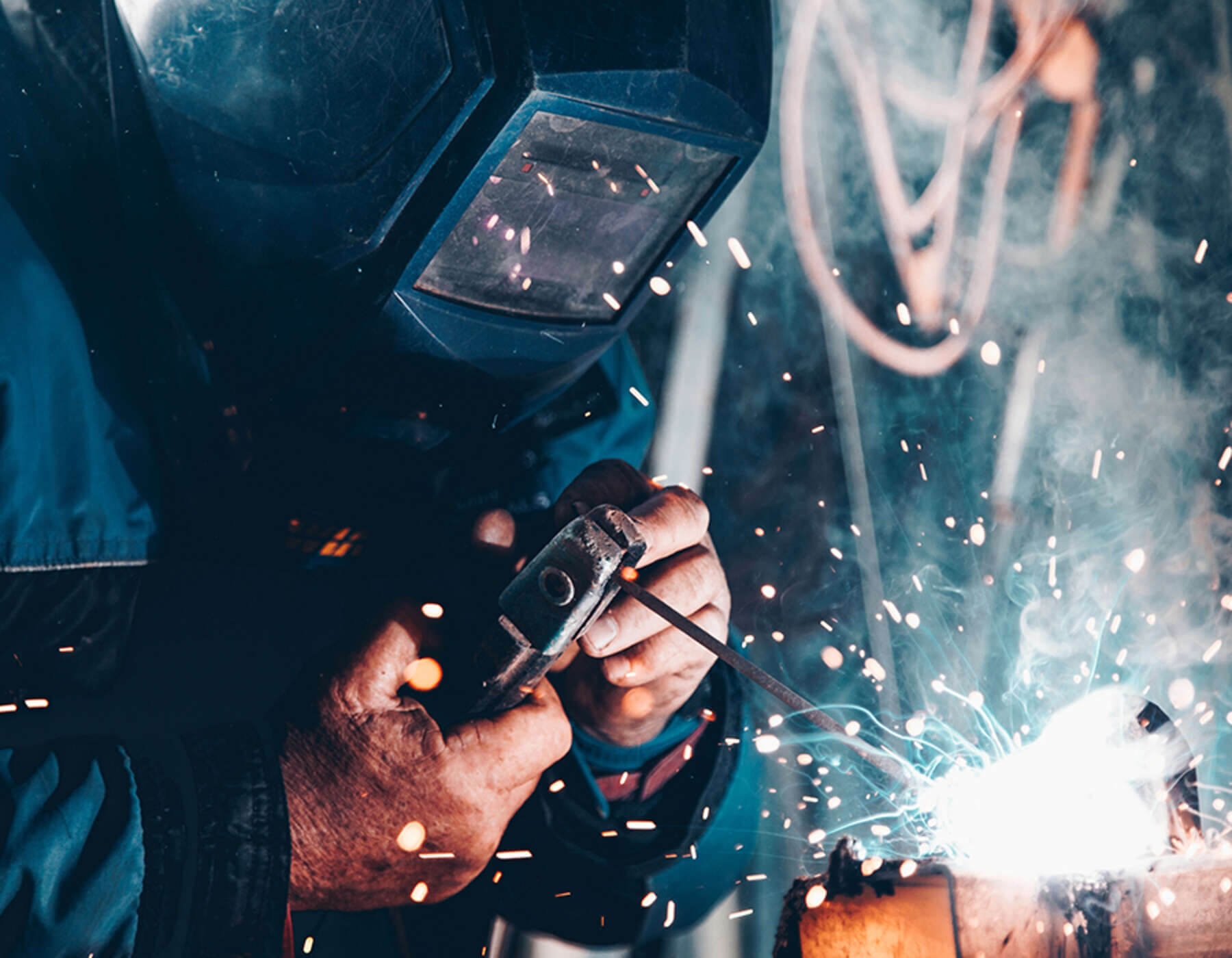

If the steel you’re buying holds up part of a building, yes, you almost certainly need an EN 1090 certified fabricator. Structural steelwork supplied to a UK site has to be UKCA or CE marked to BS EN 1090-1, and a fabricator can’t do that without certified Factory Production Control.
We’re an EN 1090 certified fabricator in Washington, Tyne and Wear, certified to Execution Class 2. This post explains what that means, how the execution class is picked, and what paperwork to ask any fabricator for, us included.
What BS EN 1090 actually is
It’s a set of standards for fabricated steel and aluminium structures. The two parts that matter for steel are:
- BS EN 1090-1 covers conformity assessment. It sets out how a fabricator proves its structural components meet their declared performance, and it’s the harmonised standard that UKCA and CE marking of fabricated steelwork hangs on.
- BS EN 1090-2 covers the technical requirements for executing steel structures. Cutting, holing, welding, bolting, tolerances, inspection and testing, all graded by execution class.
There’s also BS EN 1090-3 for aluminium structures, but that’s a different scope.
Factory Production Control
Factory Production Control (FPC) is the fabricator’s documented system for making sure what leaves the works matches the drawings and the spec. Material traceability, welding procedures, welder qualifications, inspection records, calibration, nonconformance handling.
Under the Construction Products Regulation, fabricated steelwork falls under assessment System 2+. In practice that means an approved or notified body inspects the factory and the FPC system, then keeps auditing it, usually once a year. If it’s happy, it issues an FPC certificate and a welding certificate, both stating the highest execution class the fabricator can work to. The fabricator then issues a Declaration of Performance for the products it supplies and marks them.
Execution classes EXC1 to EXC4
Execution class is how strict the fabrication, welding and inspection requirements are. EXC1 is the lightest, EXC4 the toughest. As the class goes up, you get more weld testing, tighter tolerances, more qualified welding coordination and more paperwork.
The fabricator doesn’t choose it. The structural designer does, and it should be on the drawings or in the specification. In the UK the selection now follows Annex C of BS EN 1993-1-1 with the UK National Annex, which replaced the older method in BS EN 1090-2 Annex B. It’s based on:
- Consequence class (from BS EN 1990), which is about what happens if the structure fails. CC1 is low consequence, like agricultural buildings. CC2 is medium, which takes in most offices, houses, flats and industrial buildings. CC3 is high, like grandstands and large public buildings.
- Type of loading, mainly whether fatigue is a design consideration. Mostly static loading keeps you lower. Fatigue pushes the class up, which is why bridges are generally EXC3.
- Steel grade, which can also affect the class.
SCI’s Advisory Desk note AD 394 (published in New Steel Construction) puts it plainly: EXC2 is the anticipated class for most building structures. EXC1 isn’t endorsed for general use in the UK. EXC4 is kept for structures where failure would have extreme consequences.
A fabricator certified to a given class can work at that class and anything below it. So an EXC2 fabricator can make EXC1 and EXC2 work, but not EXC3.
UKCA and CE marking: where things stand
Fabricated structural steelwork has needed CE marking in the EU since 1 July 2014. After Brexit, the UKCA mark was brought in for Great Britain, with BS EN 1090-1 kept as the designated standard.
The position as of 2026:
- Great Britain. UKCA marking applies, and in September 2024 the government said CE marking would also continue to be recognised indefinitely for construction products. The SteelConstruction.info UKCA page covers the detail.
- Northern Ireland. EU rules still apply, so steelwork needs CE marking (or CE plus UKNI). UKCA on its own isn’t valid there.
- What’s next. The government’s Construction Products Reform White Paper (February 2026) proposes keeping step with the EU’s new Construction Products Regulation, and says CE-marked products compliant with the EU regime will continue to be accepted in GB. It’s still at consultation stage, so keep an eye on it.
Either way, the fabricator still needs certified FPC behind the mark. A UKCA or CE mark on structural steel without a valid FPC certificate behind it isn’t worth much.
What to ask a fabricator for
Don’t take “yes, we’re EN 1090” on trust. Ask for:
- The FPC certificate. Check the certifying body, the certificate number, the expiry or validity date, and that it’s issued against BS EN 1090-1.
- The scope. The certificate should state the execution class and what it covers. If your job is EXC2 and the certificate says EXC1, that’s a problem.
- The welding certificate. This sits alongside the FPC certificate and confirms the welding processes, material groups and thicknesses covered. A fabricator certified for MAG welding of carbon steel isn’t automatically covered for stainless or for TIG.
- The responsible welding coordinator (RWC). EN 1090 requires a named RWC with technical knowledge that matches the execution class and the work. Ask who it is and whether they’re on site.
- Welder qualifications and procedures. Welders coded to BS EN ISO 9606, and qualified welding procedures (WPQRs to BS EN ISO 15614-1 or similar).
- A Declaration of Performance and the marking for the steelwork they deliver to you.
You can usually check a certificate with the body that issued it.
What we’re certified to (and what we’re not)
We’re certified by SCCS, UKAS Notified Body 2273, to BS EN 1090-1 and -2 for Factory Production Control at EXC2, certificate 2273-CPR-4181. We also hold BS EN ISO 3834-2:2021 for welding quality (comprehensive requirements) and ISO 9001:2015.
Our certified welding processes are 135 (MAG solid wire), 136 (flux-cored) and 138 (metal-cored), on base materials up to and including S690. Welders are coded to BS EN ISO 9606-1 and 9606-4, procedures are qualified to BS EN ISO 15614-1, and our responsible welding coordinator works on site. Visual inspection is to BS EN ISO 5817:2023, with NDT arranged through third parties when the spec asks for it.
EXC2 covers most building work: frames, mezzanines, stairs, canopies, platforms, plant supports. We don’t hold EXC3 or EXC4. If your spec calls for either, we’ll tell you straight away rather than quote and hope. Full certificates are on our accreditations page, and our structural steel fabrication page shows the kind of work we do.
FAQs
Is EN 1090 certification a legal requirement?
For structural steel components placed on the UK market, UKCA or CE marking to BS EN 1090-1 is required, and that needs certified FPC. Non-structural items like decorative screens generally fall outside it.
Who decides the execution class?
The structural designer or engineer. It should be stated in the specification or on the drawings. If it isn’t, ask before anyone quotes.
Can an EXC2 fabricator do EXC3 work?
No. A fabricator can only work up to the class on its certificate. EXC2 covers EXC1 and EXC2.
Do I need EXC3 for a normal building?
Usually not. EXC2 is the expected class for most building structures. EXC3 tends to come in with fatigue loading, like bridges, or high-consequence structures.
Talk to us
Got a spec or a set of drawings with EXC2 on them? Send them over and we’ll price it, paperwork included. Get in touch or ring 0191 816 2718.