
Why Finishing Is Critical for Steel
Steel is strong, but it’s also prone to corrosion. In the UK’s damp climate—especially near the North East coast—unprotected steel will rust. And once corrosion starts, it spreads, weakening the material and requiring expensive repairs.
Finishing serves two critical purposes:
Protection. A protective coating creates a barrier between the steel and oxygen, moisture, and corrosive elements. This barrier is what stops rust before it starts.
Aesthetics. Your fabricated structure is often visible. A well-finished surface looks professional and is finished to a standard that matches your brand and application.
The cost of finishing is a fraction of the cost of fabrication, yet it’s what determines whether your structure lasts 20 years or 50. It’s an investment that pays for itself through longevity and reduced maintenance.
Types of Finishing: An Overview
Different finishing processes offer different levels of protection, appearance, and cost. Here’s how they compare:
Galvanising is one of the most common and economical finishes. Hot-dip galvanising involves immersing steel in molten zinc, which coats every surface with a zinc layer. The process is fast, relatively cheap, and offers good corrosion protection (typically 20-50 years depending on environment). The finish is silver-grey and industrial-looking. Galvanising is ideal for structural steelwork, utility structures, and outdoor applications where aesthetics are secondary.
Paint systems (epoxy, polyester, or acrylic) are applied in multiple coats. They offer good protection and are available in any colour. However, paint requires more maintenance—annual touch-ups and repainting every 5-15 years depending on exposure. Paint is cost-effective upfront but higher maintenance long-term.
Shot blasting removes rust, scale, and contaminants from the steel surface, preparing it for coating. It’s often a precursor to painting or other finishes. Shot blasting alone (without a topcoat) offers minimal long-term protection and is usually a preparation step rather than a final finish.
Powder coating is where we focus, and it’s increasingly the finishing choice for quality projects. Read on to learn why.
Powder Coating: The Premium Finish
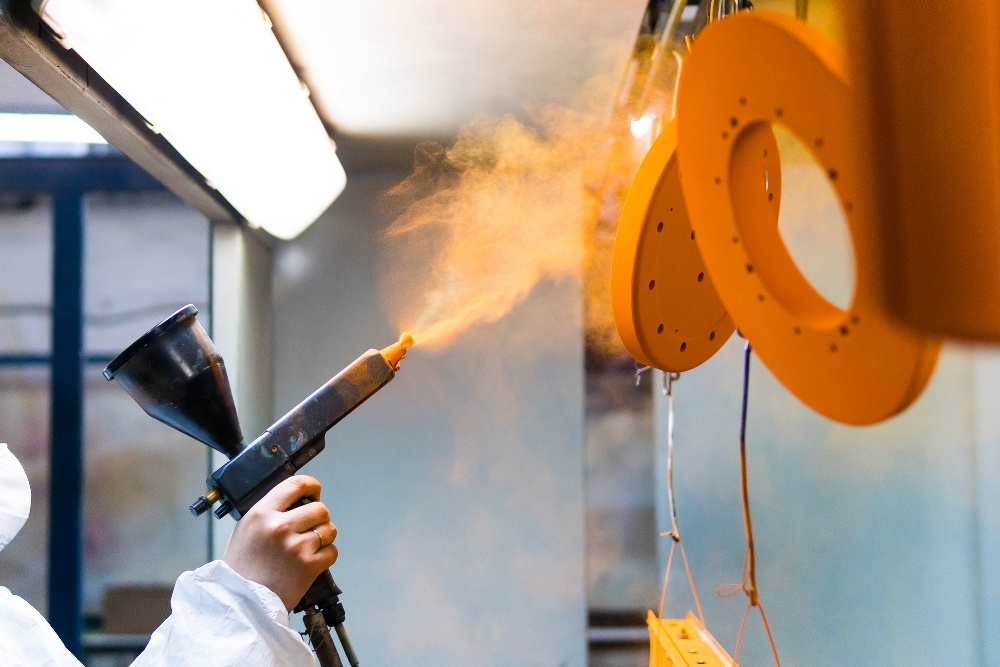
Powder coating is a process where a dry powder is applied electrostatically to the steel surface, then cured in an oven. Unlike liquid paint, powder coating is solvent-free, produces no drips or sags, and creates an exceptionally durable, attractive finish.
How it works:
The steel substrate is first cleaned and lightly abraded (usually with shot blasting). The powder is applied in a spray booth using an electrostatic gun—the powder particles are negatively charged and are attracted to the positively charged (grounded) steel. The powder sticks to every surface: flat areas, edges, inside corners, recesses. Once fully coated, the parts are moved into a curing oven, typically at 180-200°C for 10-15 minutes. In the oven, the powder melts and chemically cures into a tough, permanent coating. This is not paint—it’s a chemical transformation that creates an extremely durable finish.
Benefits:
- Exceptional durability. A quality powder coat lasts 15-20+ years with minimal maintenance, even in harsh environments. We’ve seen powder-coated industrial equipment still looking pristine after 25 years.
- Complete coverage. Every surface gets coated, including hard-to-reach areas. No drips, runs, or missed spots.
- Attractive appearance. Powder coatings offer a smooth, uniform finish that looks professional and high-quality. The finish is scratch-resistant and doesn’t fade quickly.
- Colour options. Powder comes in thousands of colours and finishes: gloss, satin, matt. RAL colours are standard in the construction and industrial sectors, allowing you to specify exact shades.
- Environmental benefits. No volatile organic compounds (VOCs) or solvents. Powder overspray is collected and can be reused. Zero waste goes to landfill. It’s the greenest finish available.
- Cost-effective long-term. Although the upfront cost is higher than paint, the lifespan and minimal maintenance make it cheaper over the life of the structure.
Powder coating and RAL colours:
If your design calls for a specific colour—say, a modern architectural finish in RAL 7016 (anthracite grey) or RAL 3000 (flame red)—powder coating is your answer. RAL is the international colour matching standard, and powder coating manufacturers stock or can match virtually any RAL colour. This is why architects and designers specify powder coating for buildings, cladding, and high-visibility structures.
MorFabrication’s Powder Coating Capability
We have in-house powder coating at our Washington, Tyne and Wear facility. Our oven is 3 metres wide, 3.5 metres tall, and 8 metres long—large enough to coat complete assemblies, massive structural sections, or hundreds of smaller components in a single run.
We use a Gema OptiFlex Pro B electrostatic spray system, a professional-grade setup that delivers consistent, high-quality coats. This isn’t a rough-and-ready operation; it’s a precision finishing process backed by years of experience.
Benefits of having us handle your finishing:
- Integrated service. Your fabrication and finishing happen in-house. No trucking parts between facilities, no waiting for external finishers. Faster turnaround.
- Quality assurance. We control every stage: surface preparation, application, curing, quality inspection. You get consistency and accountability.
- No hidden costs. No surprise finishing charges or delays. Everything is coordinated in-house.
- Local. We’re based in Washington, serving the North East. No long lead times, just local service.
When to Choose Powder Coating, Galvanising, or Paint
Choose powder coating if:
- You need a durable, attractive finish that lasts 15-20+ years
- Colour and appearance matter (architectural, decorative, or brand-critical applications)
- Environmental credentials are important (no VOCs, recyclable overspray)
- You want minimal ongoing maintenance
- You’re specifying RAL colours
- Your budget allows for premium finishing
Examples: architectural cladding, office or commercial structures, high-spec industrial equipment, artistic metalwork.
Choose galvanising if:
- You need economical protection for outdoor utility structures
- You’re cost-constrained upfront
- Industrial/utilitarian appearance is acceptable
- You’re building transmission towers, utility racks, or similar structures
Examples: temporary scaffolding, utility platforms, agricultural structures, cost-conscious industrial installations.
Choose paint if:
- You’re renovating existing structures and can’t remove them for coating
- You need touch-up capability and incremental maintenance
- Your structure is indoors and protected from UV and moisture
Paint is less common for new fabrication because powder coating outperforms it on every metric.
Steel Finishing and Wider Fabrication
Finishing isn’t an afterthought—it’s a conversation you should have early in your project. Some components are easier to coat than others. Tight bolt holes, recesses, and long thin sections can trap powder or paint and require special masking or application techniques. Discussing finishing at the design and fabrication planning stage ensures the process is smooth and the result is perfect.
At MorFabrication, we integrate finishing into our structural steel fabrication process. We help you choose the right finish, we design your assembly for easy coating, and we handle the whole journey from raw material to finished structure.
Protecting Your Steel Investment
Whether you’re building a portal frame, a mezzanine, a bespoke structure, or a one-off artistic piece, finishing is where durability and beauty meet. A well-finished steel structure is an investment that pays dividends—it looks good, performs reliably, and lasts for decades with minimal fuss.
Want to discuss finishing options for your project? Our team at MorFabrication is here to help. We can advise on whether powder coating, galvanising, or paint is right for you, handle the whole process in-house, and deliver a finished structure you’ll be proud of.
Call us on 0191 8162718 or email info@morfabrication.com. Let’s talk about how to protect your investment and keep it looking great.
For more on our finishing services, visit powder coating or explore how we integrate finishing into structural steel fabrication and metal fabrication projects.