

We get asked for Corten more and more. Planters, cladding panels, signage, garden edging, feature walls. It’s a good material when it’s used in the right place and detailed properly, and a disappointing one when it isn’t. This is what we tell architects, landscapers and contractors before they commit to it.
We’re a steel fabricator in Washington, between Newcastle and Sunderland. We can cut, form, weld and deliver weathering steel fabrications across the North East and the rest of the UK.
What is Corten steel?
“Corten” (COR-TEN) is a trade name. The generic term is weathering steel, and in the UK it’s bought to BS EN 10025-5. The grades you’ll see most are S355J0W, S355J2W and S355K2W, plus the “WP” variants such as S355J0WP, which have a higher phosphorus content and are usually supplied as thinner sheet. S355J2W is the grade most commonly used for bridges here.
It’s a low-alloy structural steel with small additions of copper, chromium and nickel. Strength-wise it behaves much like ordinary S355, so it can be designed and fabricated as structural steel. The difference is what happens on the surface.
How the patina forms
Ordinary steel rusts, the rust flakes off, fresh steel underneath rusts, and on it goes. Weathering steel forms a tight, dense oxide layer that sticks to the surface and slows further corrosion right down.
That layer needs repeated wetting and drying to form. Rain, then sun and wind, then rain again. In the UK it usually takes a year or two to settle to the even dark brown people are after, and the colour depends on exposure. A south-facing panel and a sheltered one on the same job won’t match for a while.
It still loses some steel. For bridges, the guidance on SteelConstruction.info adds a corrosion allowance per exposed face of 1.0 mm in a C3 environment and 1.5 mm in C4 over a 120-year design life. On a 3 mm planter that matters more than on a 20 mm bridge flange, so think about thickness if it needs to last.
Where weathering steel works, and where it doesn’t
It’s at its best in open, inland air where it can dry out between showers. Most of the North East away from the coast is fine.
Where it struggles:
- Near the sea. Chlorides stop the patina protecting properly. Bridge guidance says generally not within 2 km of coastal waters unless airborne chloride levels are low. That’s worth checking for anything in Seaham, Whitley Bay or down the Tees.
- Constantly wet or buried. Steel sitting in soil, in standing water, or covered in vegetation never gets its dry cycle. It corrodes at roughly the rate of ordinary steel. Planters need thought here, more below.
- De-icing salt. Splash from gritted roads and paths causes problems. Avoid it at ground level next to a gritted route, or plan to protect the lower section.
- Next to light-coloured surfaces. Run-off staining is real and it’s heaviest in the first months. Rust-coloured water will mark paving, render and stone below. Plan drip edges and drainage, or accept it.
Detailing for fabrication
Most Corten problems we see come from water being trapped. A few rules we follow, and that we’d ask designers to build in:
- Avoid pockets, overlaps and crevices that hold water or debris. Seal-weld laps or don’t have them.
- Give flat surfaces a fall. Water sat on a top edge never dries.
- Drain planters. Drainage holes in the base, and ideally lift the box off the ground on feet or a plinth so the base can breathe.
- Add drip details so run-off falls clear of what’s underneath.
- Line planters, or at least keep wet soil off the inside face. A liner helps the inside of the box last.
- Think about the fixings. Mixing in mild steel or galvanised bolts gives a different look and can stain.
Welding needs care too. BS EN 1090-2 calls for “matching” consumables on weathering steel, meaning a wire or electrode with similar alloying so the weld weathers at the same rate and colour as the parent plate. A standard mild steel wire will rust differently and can show up as a line along every joint. For some single-run fillet welds, plain C-Mn consumables can be acceptable, but that’s something to agree up front, not decide on the shop floor.
Our welders are coded to BS EN ISO 9606-1 and we work under BS EN ISO 3834-2 and BS EN 1090 to EXC2. Weathering steel goes through the same welding procedures and inspection as the rest of our structural steelwork, with mill certs and traceable batch records.
Typical Corten fabrications
- Planters and raised beds, from single boxes to long runs for public realm work
- Cladding panels and screens, including CNC-profiled patterns
- Signage, lettering and entrance features
- Landscape edging and low retaining edges
- Architectural features, fire pits, canopies and gates
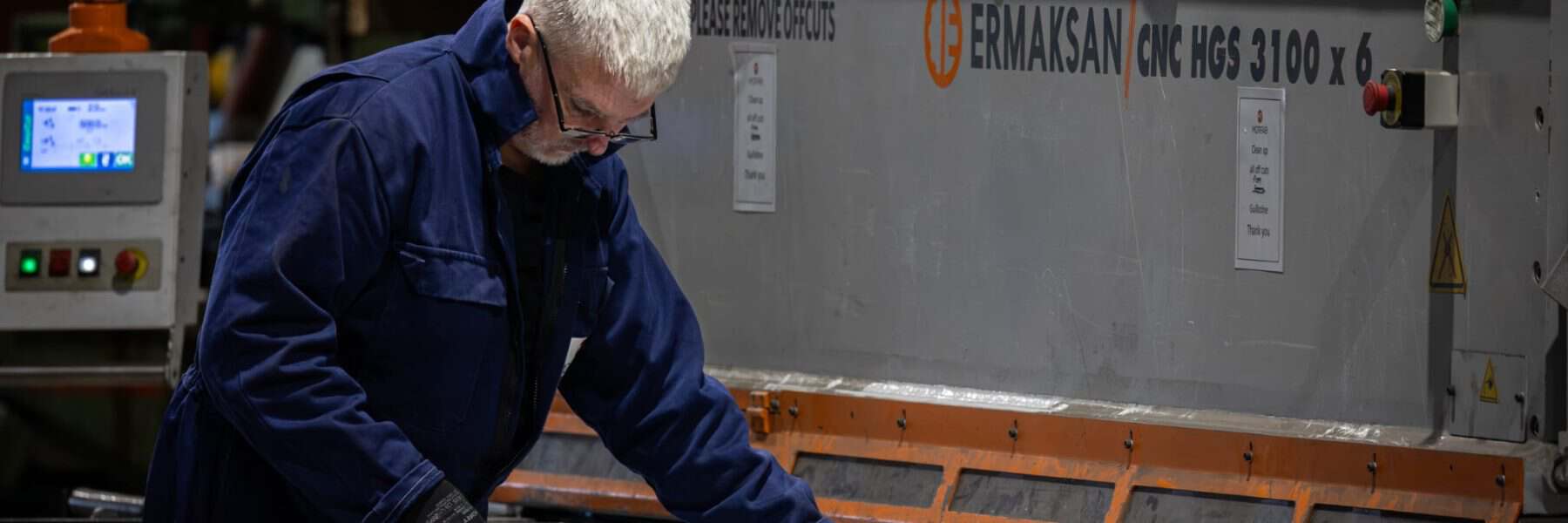
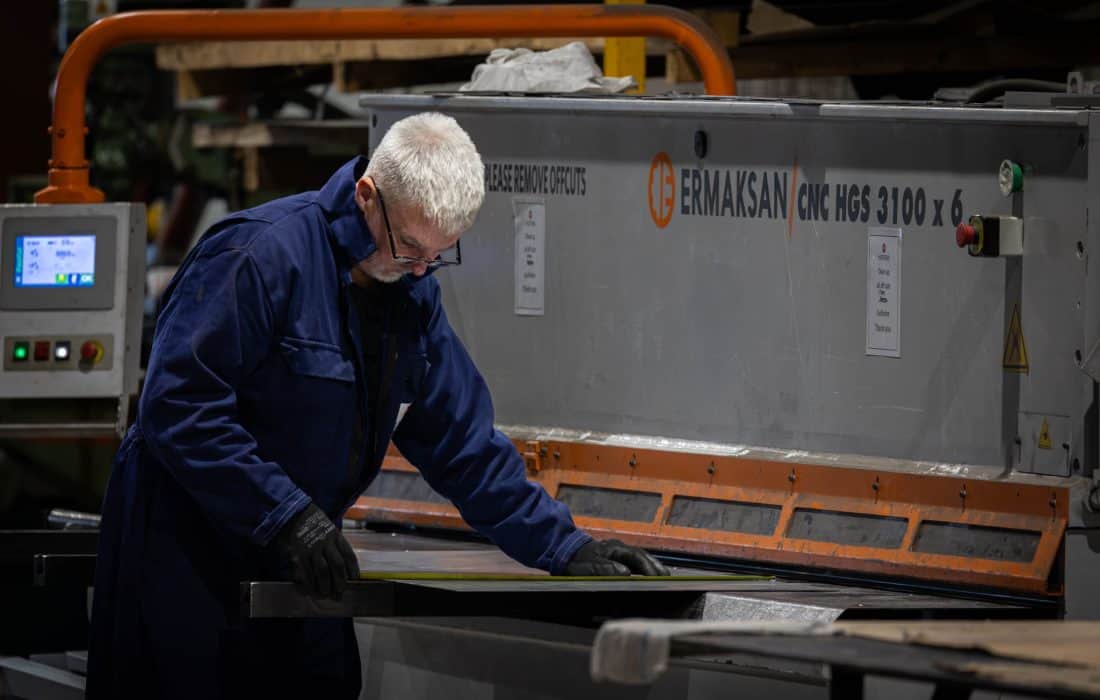
Sheet work is cut on our CNC profiling kit and folded on the press brake in our metal forming section. Bigger pieces go under the overhead cranes, and we can handle fabrications up to 10 tonnes.
Cost: Corten vs mild steel and paint
Weathering steel costs a bit more per tonne than plain S355 and it isn’t always stocked in every thickness, so lead times on material can be longer. What you save is the coating. There’s no blasting, no paint and no maintenance repainting, provided it’s in the right environment.
For bridges, studies of UK schemes found the initial cost was very close to painted steel, with whole-life cost much lower. For a run of planters, the sums are simpler. Corten usually wins if you want the rusted look and won’t be touching it again. If you want a colour, a crisp finish, or it’s going near the coast, mild steel with a coating is the better choice. We powder coat in-house in an 8 m oven, and there are textured rust-effect and dark bronze finishes that get you close to the look without the run-off.
Corten steel fabrication FAQs
Is Corten the same as weathering steel?
Yes, in practice. COR-TEN is a brand name. Most UK fabricators buy weathering steel to BS EN 10025-5, in grades such as S355J0W, S355J2W or S355J0WP.
How long does Corten take to rust to its final colour?
Usually a year or two outdoors in the UK, depending on how exposed it is. It starts orange and darkens over time. It needs wet and dry cycles, so sheltered faces change more slowly.
Can you use Corten near the coast?
Generally not within about 2 km of the sea without checking chloride levels. Salt stops the protective layer forming properly, and the steel keeps corroding.
Does Corten stain paving?
Yes, especially in the first months. Plan drip details, drainage and gravel strips, or put it where staining won’t matter.
Can Corten be welded?
Yes. Use matching weathering-steel consumables so the welds weather at the same rate and colour, and agree any exceptions with the fabricator up front.
Talk to us about your Corten job
Send us drawings or a sketch with sizes, quantities and where it’s going, and we’ll come back with a price and any detailing we’d change. Get in touch here or ring us on 0191 816 2718.