
Short answer: galvanising is the tougher corrosion protection, powder coating gives you the colour and finish, and for anything outdoors that needs to look good for a long time, you do both. That’s a duplex system. The rest of this post explains why, and when each one on its own is the right call.
We powder coat in-house at our Washington works and arrange hot-dip galvanising through a galvaniser, so we deal with all three routes every week.
How powder coating protects steel
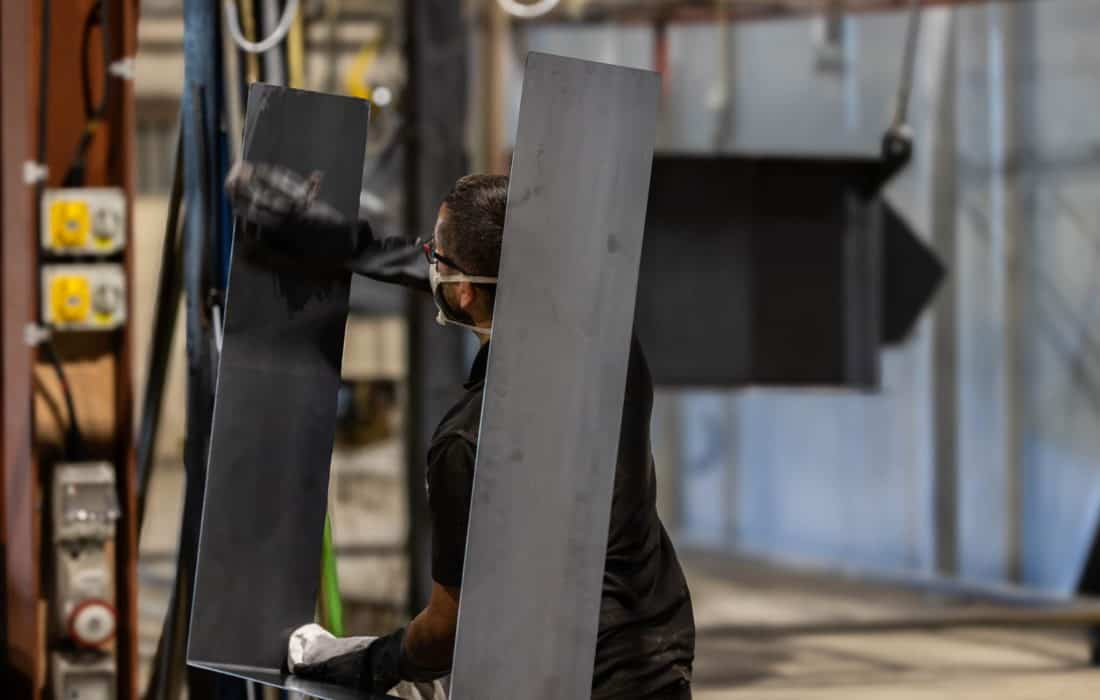
Powder coating is a dry paint. Fine powder is sprayed on electrostatically, then the work goes into an oven where the powder melts, flows out and cures into a hard film. It’s a barrier. As long as that film is intact, moisture and oxygen can’t reach the steel.
The weak point is damage. If the film gets chipped down to bare steel, rust can start there and creep underneath. So the prep before coating matters as much as the powder, along with the film thickness and edge coverage.
Our oven is 8 m long, 3.5 m high and 3 m wide, so most fabrications go through in one piece. We coat to BS EN 13438 and ISO 12944, with Qualicoat Class 2 specifications available, in any of 213 RAL Classic colours. There’s more on that in our post on powder coating standards.
How galvanising protects steel
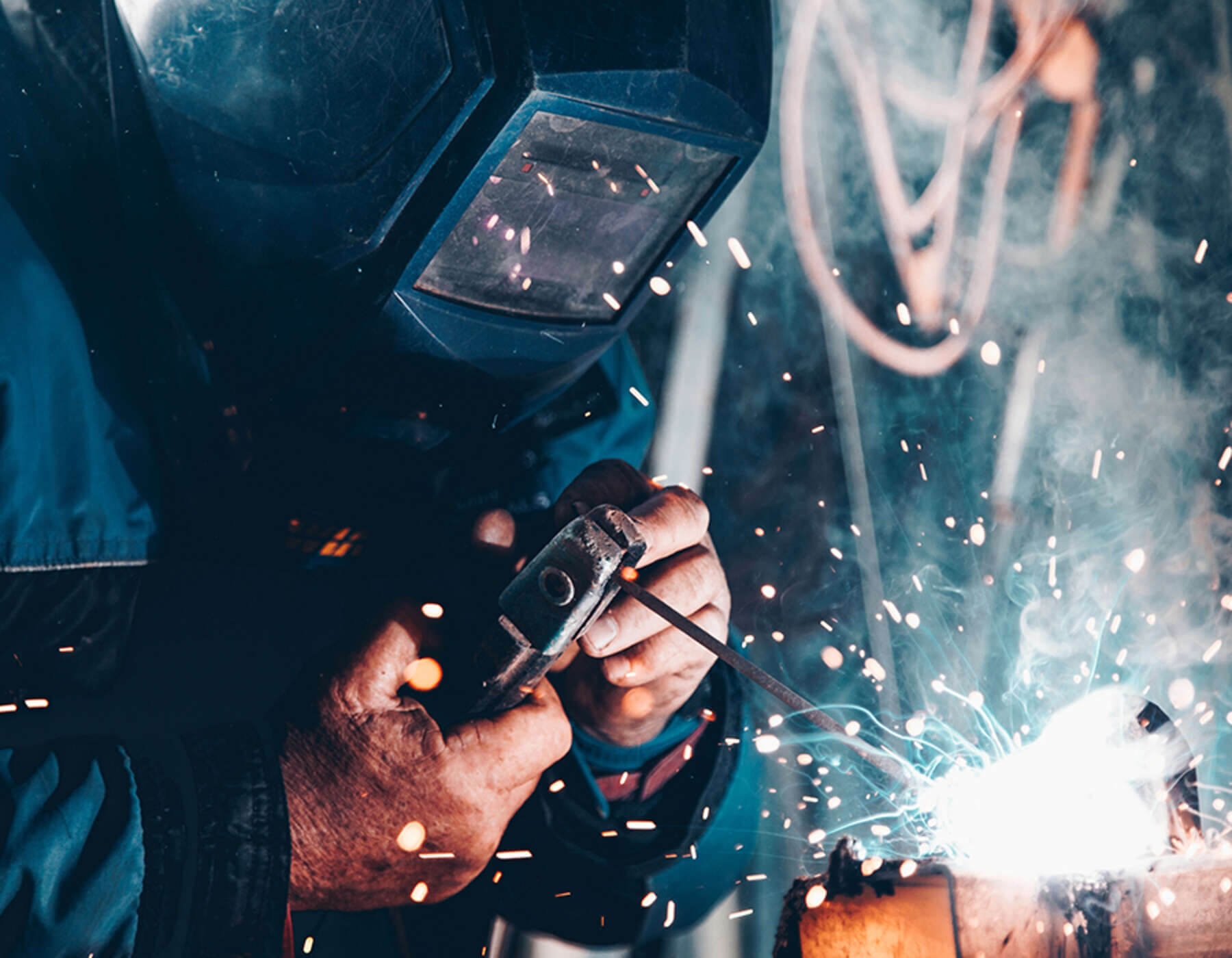
Hot-dip galvanising means dipping the cleaned steel in molten zinc at around 450°C. The zinc reacts with the steel and forms layers of zinc-iron alloy with pure zinc on top. It’s bonded to the steel, not just sitting on it.
Zinc protects two ways. It’s a barrier, and it’s sacrificial. If the coating is scratched, the zinc around the damage corrodes in preference to the steel. That’s why a galvanised gate post with a scuff on it doesn’t rust the way a painted one does.
The standard is BS EN ISO 1461. It sets minimum coating thickness by steel thickness, for example a mean of 85 µm on steel over 6 mm and 70 µm on steel over 3 mm up to 6 mm. The Galvanizers Association has the full table. Design for galvanising is covered by ISO 14713, and it matters: hollow sections need vent and drain holes, and thin, large flat panels can distort in the bath.
How long does each last?
It depends on where it’s going. ISO 12944-2 sorts environments into corrosivity categories:
- C1 very low: heated indoor spaces
- C2 low: rural areas, low pollution
- C3 medium: urban and light industrial, moderate pollution
- C4 high: industrial areas, coastal with moderate salt
- C5 very high: aggressive industrial and coastal sites with heavy salt
- CX extreme: offshore and extreme industrial
For galvanising, life is roughly coating thickness divided by zinc corrosion rate. Published zinc corrosion rates run at about 0.7–2.1 µm a year in C3, 2.1–4.2 µm in C4 and 4.2–8.4 µm in C5. So 85 µm of zinc in a C3 urban setting has a long way to go. Near the coast it goes a lot quicker.
For paint and powder systems, ISO 12944 uses durability ranges instead: low (up to 7 years), medium (7–15), high (15–25) and very high (over 25). That’s time to first major maintenance, not a guarantee. A powder coating on bare steel in C2 or C3 can do well. In C4 or C5 on its own, we’d usually steer you away from it.
Appearance and colour
Galvanising comes out silver-grey, sometimes spangled, sometimes dull and patchy depending on the steel chemistry. It weathers to a flat grey. You don’t get to choose. Fine on a farm gate or a hidden bracket, often not what an architect wants on a balustrade.
Powder coating gives you any RAL colour in matt, satin or gloss, an even finish and crisp edges. On our Everton Stadium metalwork, finish was a big part of the brief, and that was all coated in-house.
Cost and turnaround
On plain steelwork, galvanising alone is usually the cheaper of the two per tonne, and powder coating alone is cheaper than doing both. Duplex costs the most because it’s two processes plus extra prep in between.
Turnaround is where in-house coating helps. Powder coating happens under our roof, so it’s scheduled with the fabrication. Galvanising means transport to the galvaniser and back, and you’re working to their schedule. Duplex adds that trip before the work comes back to us for coating.
Duplex: powder coating over galvanising
A duplex system lasts longer than either coating on its own. The powder protects the zinc from weathering, and the zinc stops rust creeping under any damage to the powder. Industry figures quote duplex life at 1.5 to 2.3 times the two lifetimes added together.
The catch is prep. Galvanised steel is one of the harder surfaces to powder coat well. The European standard for this is BS EN 15773, which covers duplex systems with powder coatings over galvanised steel. The main issues:
- Surface oxides and residues. Fresh zinc picks up oxides, and some galvanisers quench or passivate the steel after dipping. Both hurt adhesion. The galvaniser should be told up front it’s going for powder coating.
- Sweep blasting or chemical pretreatment. A light sweep blast removes oxides and gives a key without stripping the zinc. A pretreatment designed for zinc surfaces can be used as well as, or instead of, blasting.
- Outgassing. Air and moisture trapped in the zinc layer expand in the curing oven and blow pinholes and craters through the powder. The usual fix is a pre-bake above the cure temperature to drive it out, then coating soon after. Some powders are formulated for galvanised work too.
- Timing. Coat as soon as practical after prep, before the zinc starts to re-oxidise.
Handled properly, duplex is what we’d recommend for coastal and exposed sites, public realm work and anything where both colour and long life are in the spec.
When to choose which
- Powder coating only: indoor work, C2–C3 outdoor work where colour matters, and anything you can inspect and touch up.
- Galvanising only: structural steelwork, hidden steel, agricultural and industrial kit where looks don’t matter but long life does.
- Duplex: balustrades, railings, gates, canopies and street furniture outdoors, coastal sites, and anything that has to look right for a long time.
Powder coating vs galvanising FAQs
Is powder coating better than galvanising?
Not for corrosion protection on its own. Galvanising protects steel sacrificially and is more forgiving of damage. Powder coating wins on colour and finish. Duplex gets you both.
Can you powder coat galvanised steel?
Yes, but it needs the right prep: removing zinc oxides with a sweep blast or suitable pretreatment, and degassing to stop outgassing in the oven. BS EN 15773 covers it.
How long does galvanising last?
It depends on coating thickness and the environment. Zinc loses roughly 0.7–2.1 µm a year in a C3 urban environment, so a typical BS EN ISO 1461 coating lasts decades. Coastal sites are much harder on it.
Does MorFab galvanise in-house?
No. We arrange galvanising with a galvaniser and handle the fabrication, the prep for coating and the powder coating ourselves.
Not sure which finish to specify?
Tell us what it is and where it’s going and we’ll suggest a finish and price it. See our powder coating service, contact us here or ring 0191 816 2718.